Canadian research · Adults age 65 and older
About 2.2 million Canadian seniors lived alone in 2024, according to the Canadian Housing Survey. That represents approximately 28.9% of seniors in the population covered by the survey—not every older adult in Canada. [1][2]
This page brings together the newer housing-survey estimate, Census age breakdowns, provincial examples and evidence about social connection. Each section identifies its data year and population.
Last reviewed: · Newest reference year: 2024 · Age breakdowns: 2021 Census
Key seniors living alone statistics
How many Canadian seniors live alone?
Statistics Canada estimates that 2,209,800 people age 65 and older lived alone in 2024 within the Canadian Housing Survey’s covered population. A further 5,429,300 seniors lived with other people. Together, these groups account for 7,639,100 older adults in that survey population. [1]
| Living arrangement | Estimated people age 65+ |
|---|---|
| Living alone | 2,209,800 |
| Living with other persons | 5,429,300 |
| Total in the covered survey population | 7,639,100 |
Source: Statistics Canada, Table 46-10-0068-01. Geography: Canada, provinces only. Estimates are rounded. The published 95% confidence interval for seniors living alone is 2,123,743 to 2,290,200. [1]
Who is included? The Housing Survey covers the 10 provinces. It excludes residents of institutions, people living on reserves and settlements, and Canadian Forces members living in military camps. The estimate does not cover the territories and should not be described as a complete headcount of all Canadian seniors. [2]
What percentage of Canadian seniors live alone?
Within the 2024 Housing Survey’s covered senior population, the calculated share is 28.9%, or close to three in ten. We divide the estimate living alone by the total senior population in the same table: 2,209,800 ÷ 7,639,100 × 100, rounded to one decimal place. [1]
This is a Seniors Bulletin calculation from published, rounded counts. We have not calculated a confidence interval for the resulting percentage. It should not be combined with a population estimate from another year or with a different definition of the senior population.
The table’s default percentage column shows 100% for each group when all housing situations are selected. That column answers a different question; it is not the percentage of seniors who live alone.
Seniors living alone by age
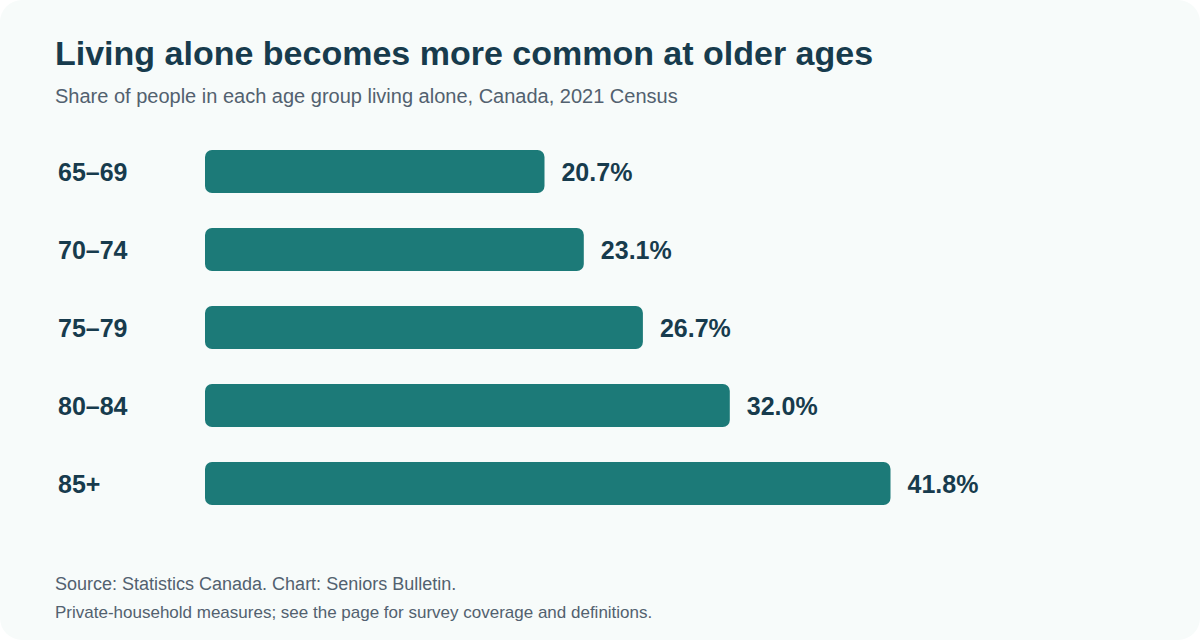
The 2021 Census provides a consistent age comparison for people living in private households. The share living alone rises from 20.7% at ages 65–69 to 41.8% at age 85 and older. These percentages do not include people living in collective dwellings, such as long-term care facilities. [3]
| Age group | 2016 | 2021 | Change, percentage points |
|---|---|---|---|
| 65–69 | 20.2% | 20.7% | +0.5 |
| 70–74 | 22.8% | 23.1% | +0.3 |
| 75–79 | 26.7% | 26.7% | +0.0 |
| 80–84 | 33.0% | 32.0% | -1.0 |
| 85+ | 43.3% | 41.8% | -1.5 |
Source: Statistics Canada’s Census living-arrangements table. Percentages use each age group in private households as the denominator. A percentage-point change is the difference between the two rates, not a percentage increase in the number of people. [3]
Seniors living alone by province: two Census examples
In 2021, 494,545 seniors in Quebec and 235,425 in British Columbia lived alone. The table uses people age 65+ in private households for both denominators. These are selected provincial examples, not a complete Canadian ranking. [7][8]
| Province | Living alone | All seniors in private households | Share living alone |
|---|---|---|---|
| Quebec [7] | 494,545 | 1,599,990 | 30.9% |
| British Columbia [8] | 235,425 | 964,730 | 24.4% |
Shares are Seniors Bulletin calculations from the cited counts, rounded to one decimal. Collective dwellings are excluded; counts are rounded independently.
Quebec’s source also reports 28.2% using all seniors, including those in collective dwellings. Our 30.9% uses its private-household count instead: 494,545 ÷ 1,599,990 × 100. The denominator explains the difference. [7]
Are older women more likely than older men to live alone?
Yes, in both provincial examples below. The percentages describe the share of each group living alone, not the gender composition of all solo-dwelling seniors. [7][8]
| Province | Men age 65+ | Women age 65+ |
|---|---|---|
| Quebec [7] | 23.5% | 37.5% |
| British Columbia [8] | 17.7% | 30.3% |
Calculated from each group’s living-alone and private-household counts in the CSV. The 2021 Census two-category gender groups include some non-binary people; ISQ labels them Men+ and Women+, while the SFU publication uses males and females. These provincial figures are not national estimates. [7][8]
Is living alone becoming more common among seniors?
It depends on the age group and the measure. Between the 2016 and 2021 censuses, the living-alone share increased slightly for ages 65–69 and 70–74, was unchanged at ages 75–79, and declined for ages 80–84 and 85+. [3]
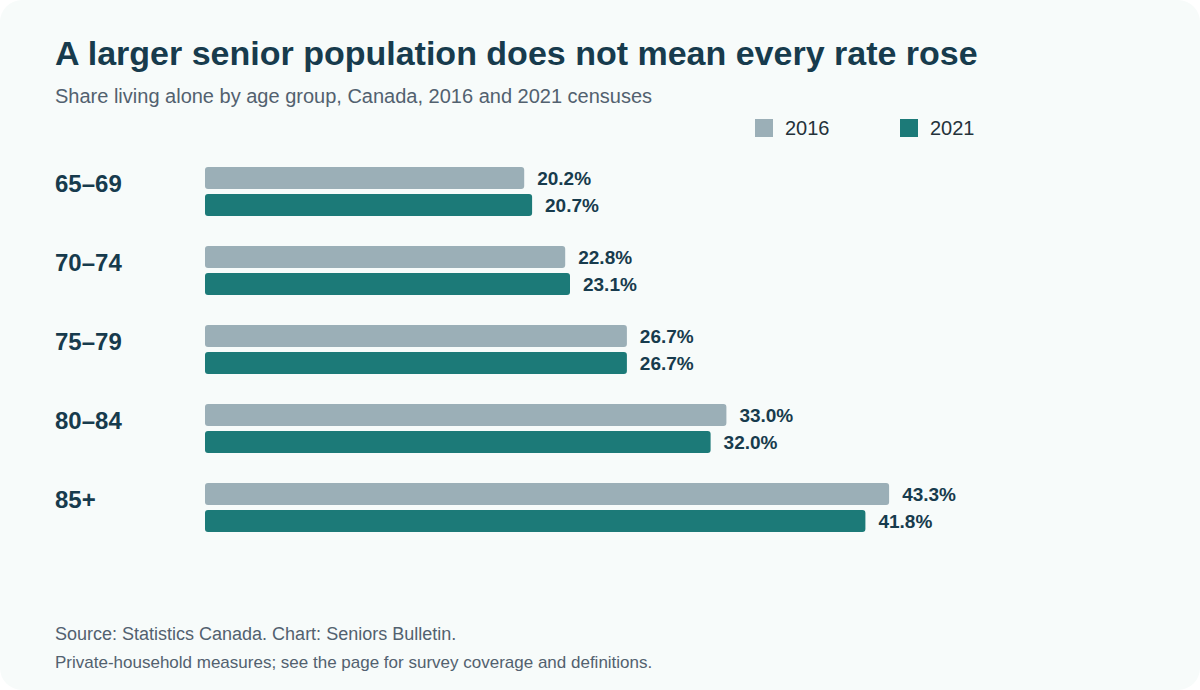
A count of people and the proportion who live alone answer different questions. An aging or growing population can produce more solo households even when some age-specific rates fall. We do not compare the 2024 Housing Survey count directly with these Census percentages to calculate a growth rate.
Financial context: unattached seniors
Statistics Canada reports that 11.1% of unattached seniors were below the poverty line in 2024. This is a separate Canadian Income Survey measure, reported in its October 1, 2026 release. [9]
“Unattached” does not necessarily mean “living alone.” It also includes people sharing a home with unrelated people. The 11.1% figure must not be presented as the poverty rate specifically of seniors who live alone. [10]
What these statistics mean for independent living
A national statistic cannot determine whether a particular person should live alone or needs equipment. Planning starts with the individual and their home:
- Agree on everyday support. Discuss check-ins, transport, shopping and who can help when plans change. Our guide to caring for older parents offers a starting point.
- Review the home together. Consider lighting, routes through rooms, access to the bathroom and how stairs fit the person’s daily routine. See our aging-in-place guide.
- Make contacting help straightforward. Keep a phone and agreed contacts accessible. If comparing a device, our Canadian medical-alert comparison explains product choices; a device does not replace a support network.
- Use evidence without assuming personal risk. Our Canadian senior-fall statistics explain a different dataset and its limitations. Living alone does not by itself establish that someone will fall.
Methodology, definitions and limitations
What does “senior living alone” mean?
For this page, a senior is a person age 65 or older. Living alone means being the only person in the household; it does not mean being unmarried, without relatives, without a caregiver, or without contact with other people. Private-household statistics should not be generalized to residents of collective or institutional settings.
Why are the data years different?
The 2024 Housing Survey supplies the newer count. Census data supply the age comparisons and selected provincial examples. The Social Survey covers family relationships and loneliness; the Income Survey supplies the separate poverty figure for unattached seniors. These are different statistical populations and instruments, not one continuous series.
When will newer Census living-arrangement data be available?
This is a 2026-reviewed page, not a 2026 Census results page. The first population and dwelling counts are scheduled for February 10, 2027. The release covering families, households and marital status is scheduled for July 14, 2027; that is the more relevant checkpoint for new living-arrangement figures. We will need to check the available tables and definitions before replacing the 2021 comparisons. [6]
How we checked the calculations
- The two 2024 living-arrangement estimates sum to the table’s senior total: 2,209,800 + 5,429,300 = 7,639,100.
- The 28.9% share uses those same survey counts and is explicitly labelled as our calculation.
- Age-specific percentages are transcribed from the published Census table; changes are calculated in percentage points.
- No Canada-wide total is extrapolated from missing geographic coverage, and no individual risk is inferred from the figures.
Download and cite the data
The CSV lists each measure’s value, year, population, geography, original source, calculation method and limitations. It keeps the different surveys and Census observations identifiable.
Download the source data (CSV)
Suggested citation: Seniors Bulletin. “Seniors Living Alone Statistics in Canada (2026).” Reviewed October 27, 2026. Compiled from the sources listed below, including Statistics Canada surveys and Census tabulations published by ISQ and SFU.
Our original charts may be shared with visible credit to Seniors Bulletin and a link to this page. Credit the underlying statistics to Statistics Canada and retain the data years and coverage notes.
Frequently asked questions
How many seniors live alone in Canada?
The 2024 Canadian Housing Survey estimates that 2,209,800 people age 65 and older lived alone in the 10 provinces. This is a survey estimate for the covered population, not a count of every senior in Canada, and it excludes institutional residents and the territories.
What percentage of Canadian seniors live alone?
Using the 2024 Canadian Housing Survey counts, Seniors Bulletin calculates 28.9%: 2,209,800 seniors living alone divided by 7,639,100 seniors in the covered population. This percentage does not use all seniors in Canada as its denominator.
Which older age group is most likely to live alone?
Among the senior age bands in the 2021 Census table used here, people age 85 and older had the highest share living alone: 41.8% of those in private households. The comparable share for ages 65–69 was 20.7%.
Does living alone mean a senior is lonely?
No. Living alone describes a household arrangement. Loneliness describes how someone feels about their social connections. A person can live alone and feel well supported, or share a home and feel lonely.
Are these 2026 Census statistics?
No. This page was reviewed in October 2026 and retains the reference year of each dataset. The first 2026 Census population and dwelling counts are scheduled for February 10, 2027. Families, households and marital status are scheduled for July 14, 2027—the more relevant release to check for new living-arrangement data. [6]
Are the provincial figures a Canada-wide ranking?
No. The provincial tables show verified 2021 Census examples for Quebec and British Columbia only. Each percentage uses seniors of the stated group in private households as its denominator; these examples do not identify the highest or lowest province across Canada.
Original sources
- Statistics Canada, Table 46-10-0068-01. 2024 Canadian Housing Survey; released September 21, 2026. Counts and published confidence interval.
- Statistics Canada, Canadian Housing Survey methodology. 2024 survey population and exclusions.
- Statistics Canada, living arrangements by age, 1981, 2016 and 2021. Census percentages for residents of private households; published July 13, 2022.
- Statistics Canada, family relationships and well-being, 2024. Canadian Social Survey, fourth quarter 2024; released February 19, 2025.
- Statistics Canada, mental health and loneliness among older Canadians. January 20, 2026 summary; loneliness results refer to fourth quarter 2024.
- Statistics Canada, 2026 Census release schedule. Population and dwelling counts: February 10, 2027. Families, households and marital status: July 14, 2027.
- Institut de la statistique du Québec, Portrait des femmes aînées au Québec — Population. 2021 Census counts adapted by ISQ; published June 29, 2023. We calculate private-household shares from the displayed counts, not the report’s all-seniors percentages.
- Simon Fraser University, Fact Book on Aging in British Columbia and Canada, eighth edition. Wister, Kim and Qiu, 2023, Table 7.1, printed pages 66–67. 2021 Census living-arrangement counts; underlying Statistics Canada Table 98-10-0134-01.
- Statistics Canada, National Seniors Day: Older Canadians are proudly Canadian. Published October 1, 2026; poverty figure refers to unattached seniors in 2024, not exclusively seniors living alone.
- Statistics Canada, Family definitions. Definition of unattached individuals; includes people living alone and those sharing with unrelated people.
Living alone is not the same as being lonely
Living alone describes who shares a household. Loneliness describes a person’s feelings about their connections; social isolation concerns the extent of those connections. None of these terms should be used as an automatic substitute for another.
The fourth-quarter 2024 Canadian Social Survey found that 75% of seniors who lived alone reported high satisfaction with their family relationships. High satisfaction meant a score of 8, 9 or 10 out of 10. The survey covered non-institutionalized people living off reserve in the 10 provinces. [4]
Separately, Statistics Canada reports that 9.2% of adults age 65 and older felt lonely always or often in the fourth quarter of 2024. That finding covers seniors overall—not just seniors living alone—and cannot be used as the loneliness rate of solo-dwelling seniors. [5]
For an older adult and their family, the useful conversation is about the person’s preferences, practical support and access to help, rather than assuming a one-person home is a problem.